

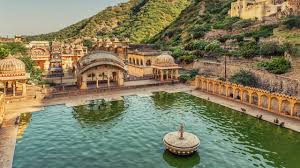
For travelers seeking spiritual and culturally immersive places to visit in Jaipur, Galtaji Temple — popularly known as the Monkey Temple — is an experience unlike any other. Nestled in a picturesque gorge of the Aravalli Hills, just 10 km from Jaipur city, this ancient Hindu pilgrimage site is a sprawling complex of shrines, natural springs, and sacred water tanks (kunds) that have drawn devotees and travelers for centuries. The temple is dedicated to multiple Hindu deities including Lord Ram, Lord Krishna, and Lord Hanuman, and is unique in its architecture — designed to resemble a grand palace or haveli rather than a conventional temple.
History and Architecture of Galtaji Temple
Galtaji Temple is a prehistoric Hindu pilgrimage site believed to have been established by the sage Galava, who is said to have meditated here for many decades and was blessed by the gods with copious natural springs. The temple complex was formally built by Diwan Rao Kriparam, a courtier of Maharaja Sawai Jai Singh II, in the 18th century. The construction is entirely in pink sandstone, harmonizing beautifully with the rose-colored rocky terrain of the Aravalli Hills. What makes Galtaji architecturally remarkable is that it resembles a royal haveli far more than a typical temple — with round roofs, painted walls, ornate pillars, and beautiful murals ranging from the 18th to 19th centuries. The complex houses seven sacred kunds (water tanks), fed by natural springs that flow from a rock shaped like a cow’s mouth (Gaumukh). The Galta Kund is considered the holiest and is believed to never run dry, no matter the season. The temples within the complex honor Lord Ram, Lord Krishna, Lord Hanuman, and Lord Vishnu, among others. Legend also holds that portions of the holy Ramcharitra Manas were composed at this sacred site by the poet Tulsidas.
Timings and Entry Fee
- Galtaji Temple is open to visitors throughout the day, from early morning (around 5:00 AM) to late evening (around 9:00 PM).
- There is no entry fee to visit Galtaji Temple — it is free for all visitors.
- However, donations are welcome as the temple complex is a living pilgrimage site maintained by the religious community.
- Photography within the premises is generally permitted, though it is courteous to ask before photographing devotees during prayers or ritual bathing.
Best Time to Visit
The best time to visit Galtaji Temple is during the morning hours when the light is soft, the atmosphere is most spiritual, and the natural springs and kunds are most active. October to March is the most comfortable period weatherwise. The temple is especially vibrant during Hindu festivals like Makar Sankranti (January), when large numbers of devotees gather to take a holy dip in the kunds. Early morning visits provide the best experience for both spiritual atmosphere and photography.
Travel Tips for Visiting Galtaji Temple
- Remove your shoes before entering the temple premises, as is customary at all Hindu temples.
- Dress modestly and respectfully — avoid shorts or sleeveless clothing.
- The site is home to hundreds of friendly monkeys — keep a firm hold on bags, spectacles, and food items as monkeys are known to snatch them.
- Don’t tease or feed the monkeys directly.
- Carry cash for donations and for purchasing offerings at the temple market.
- The temple is located on the outskirts of Jaipur, about 10 km from the city center — accessible by auto-rickshaw or cab.
- The scenic drive through the hilly terrain is itself a pleasant experience.
Conclusion
Galtaji Temple Jaipur is one of those hidden gem places to visit in Jaipur that rewards travelers who venture slightly off the beaten tourist path. With its ancient sacred springs, ornate haveli-style architecture, playful monkeys, and deeply spiritual atmosphere set within the natural beauty of the Aravalli Hills — Galtaji is a soulful counterpoint to the grand forts and palaces that dominate most Jaipur itineraries. It is a place where nature, history, and devotion converge in a uniquely beautiful way.
